Home / Forestry Mulching
ServiceBrush and small trees ground back into the ground they grew out of, so overgrown land becomes something you can walk, graze, hunt or build on again.
Free estimate•Reliable machinery•Trusted operators
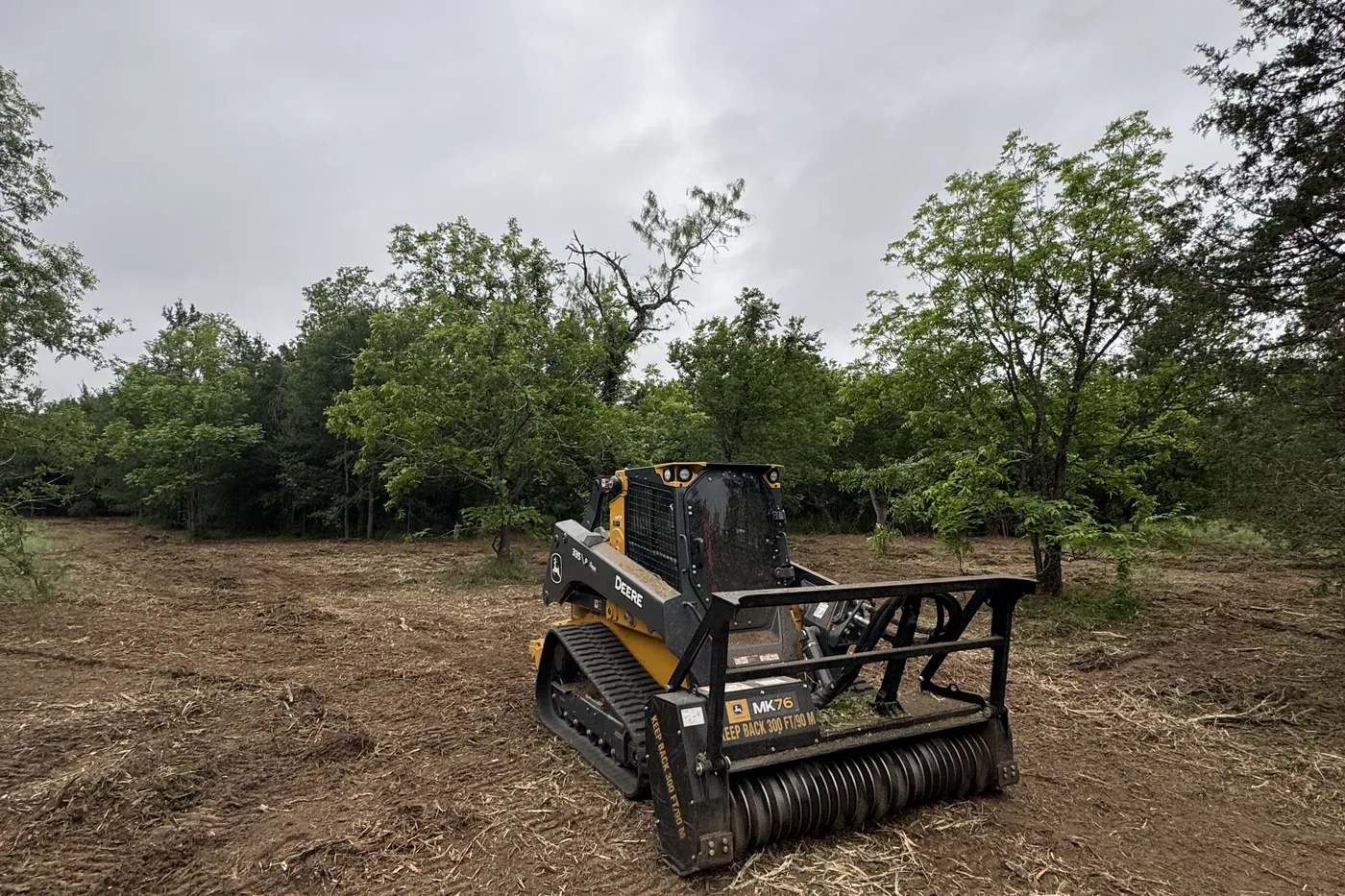
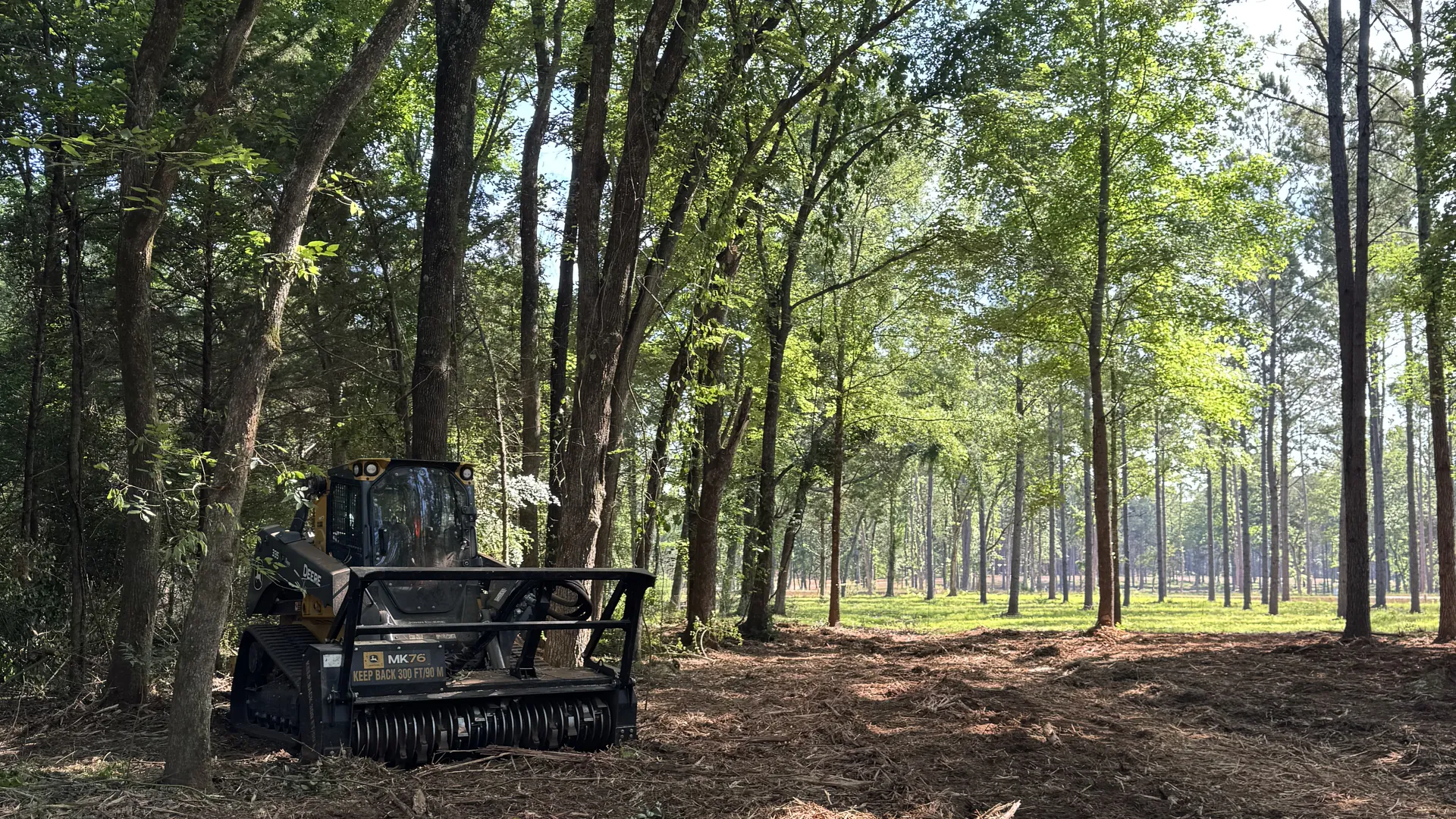
A forestry mulching head is a heavy steel drum fitted with carbide teeth, mounted on the front of a tracked machine. It spins fast enough to grind a standing sapling into chips from the top down without the tree ever hitting the ground.
Because the material never gets piled, there is nothing to load, nothing to burn and nothing to pay a landfill to take. The savings come from cutting, grinding and cleanup happening together instead of as three separate jobs.
Comfortably up to roughly 8-inch stems. See what that costs per acre. We will drop and mulch a handful of larger trees where they are in the way, but this is not a machine for taking big timber off a property — that is dozer and grapple work. What mulching does best is everything under and around the trees you are keeping.
| Forestry mulching | Dozer & burn | |
|---|---|---|
| Passes required | One | Cut, pile, burn or haul |
| Debris | Stays as mulch | Burn pile or dump fees |
| Ground left behind | Covered, root mat intact | Bare, scraped, stump holes |
| Erosion risk | Low | High until it revegetates |
| Burn ban impact | None | Can stall the job for weeks |
| Selective clearing | Yes, tree by tree | Difficult |
| Best for | Understory, reclamation, access, wildlife | Grade work, stump removal, full site prep |
Where a dozer still wins: if you need stumps out and dirt moved to grade for a slab or a pond, that is dozer and excavator work. Mulching handles vegetation, not earthmoving. Plenty of jobs use both — see what we clear and where we work.
Call or fill out the form with the location and rough acreage. A dropped pin or an address is enough for us to pull it up on satellite before we drive out.
Density drives cost more than acreage does. We look at stem size, how thick the understory is, slope, and how a trailer gets in. Then you get a firm number.
The mulching head grinds standing brush and small trees where they stand. No burn piles, no dump trailers, no gate ruts from hauling debris out.
You look it over while the machine is still on site. If a spot needs another pass, we make it then and there.
Open the understory and you get browse at deer height, shooting lanes, and sunlight to the ground for food plots.
Take back hay ground that cedar, mesquite or yaupon has been creeping into a few feet a year.
Clear a pad, a driveway route and a septic field while keeping the mature trees that made you buy the lot.
Cut a road a truck and trailer can actually use, and open a fence row so you can find and fix your wire.
Knock down the slash and scrub left after a thinning so the stand is walkable and replantable.
Pull the fuel load back from structures, propane tanks and property lines before fire season.
Density sets the price. See the full cost breakdown for how we estimate, or send us the property and we will price it.
Day-rate and hourly work generally runs $200 to $350 an hour depending on the machine and the ground. For most acreage jobs a per-acre or per-day price is easier for everybody to plan around.
For vegetation, usually yes, because there is no second and third pass to pile and dispose of material. For jobs that need stumps out and dirt moved, a dozer is the right tool and mulching does not replace it.
Light understory can move at two to four acres a day. Heavy thicket can be well under an acre. Anyone who quotes you acres per day without seeing the property is guessing.
Tell us where the property is and roughly how much needs clearing. We will get back to you with a plan and a price, not a sales pitch.