Home / Service Areas / Burleson
Johnson County, TexasLand on the fast-growing south side of Fort Worth closes in fast. We open it back up — pasture you are losing, a fence row you cannot get down, a trail that grew shut, a lot you are ready to build on.
Free estimate•Reliable machinery•Trusted operators
Around Burleson we spend most of our time on new-build acreage and horse property. Whether it is a homesite, a hunting tract or pasture you want back, the approach is the same: grind what is standing, leave what you want, and put a mulch layer down instead of bare dirt. That is how forestry mulching works, and it is most of what we do around Johnson County.
The brush we deal with most in Johnson County is post oak, cedar and greenbriar. Cedar and greenbriar come back hardest here, so most tracts want a light touch-up pass in year three or four. If you want the whole tract opened up rather than just the understory, that is full land clearing and we price it the same way — by how thick it is.
Cross Timbers ground is thick with post oak and blackjack that most owners want kept. Mulching clears everything under them without scarring the trunks. You can see what that runs on the Texas land clearing price guide, or price your own acreage in about thirty seconds.
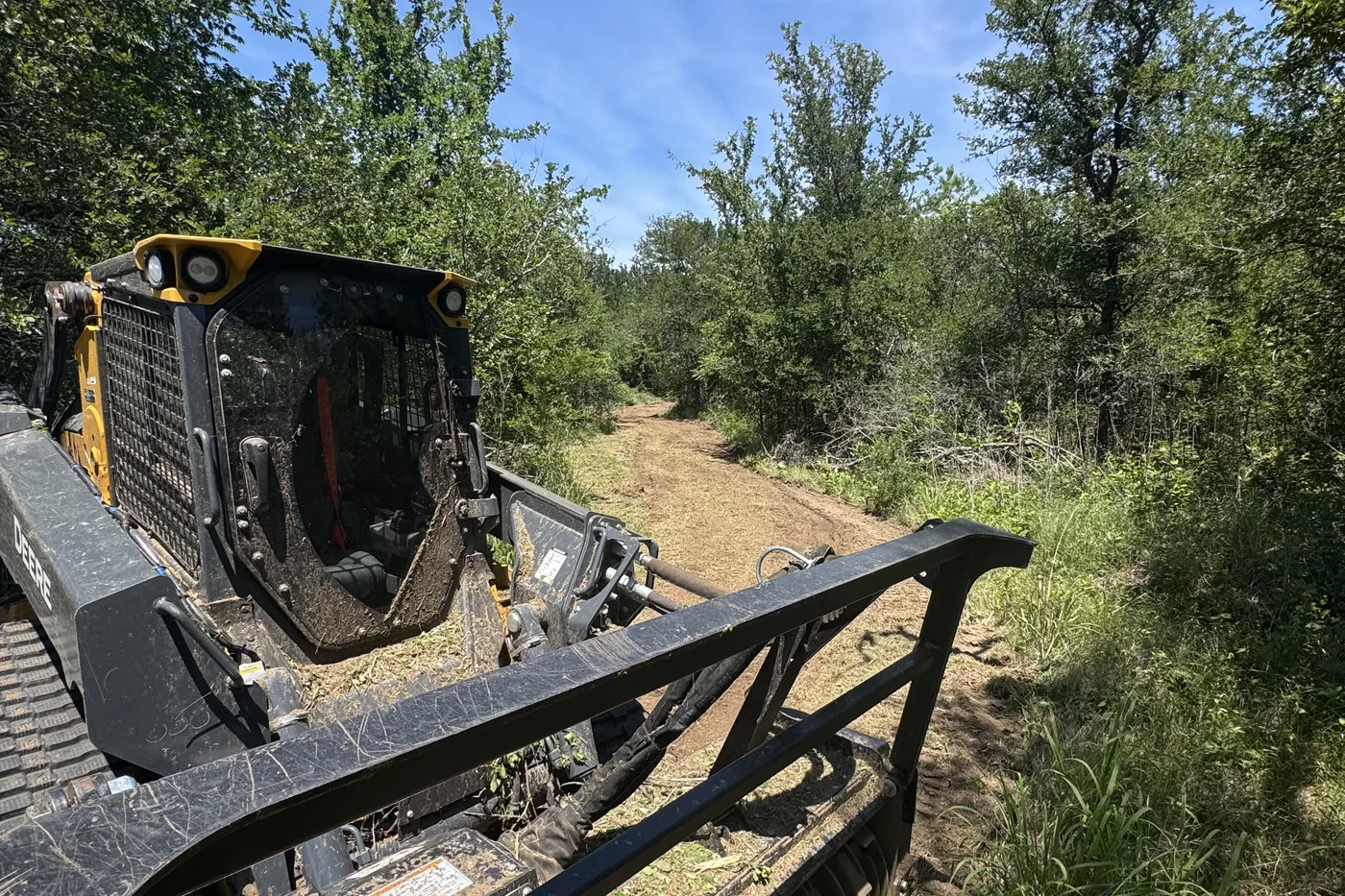
Thick brush and small trees ground down in place. Sight lines back, walkable ground back, no debris pile left behind.
Pad, driveway and septic area cleared for a build while the trees worth keeping stay standing.
A clean lane down the fence row across Johnson County so you can see your wire and keep brush off it.
Take grazing and hay ground back from the brush line that has been creeping in a few feet a year.
Lease roads, ranch trails and walking paths cut wide enough for a truck and trailer to use.
Shooting lanes, browse at deer height and sunlight to the ground for food plots on Johnson County tracts.
Tell us where the property sits in Johnson County and we will come look at it. Typical rate is $1,800 an acre, $1,800 minimum.
Density drives the price more than acreage. Here is the range we work from around Burleson — $1,800 is a full day and also the minimum on any job. The full price guide explains what pushes a quote up or down.
| Density | What it looks like | Per acre |
|---|---|---|
| Light | Scattered brush over grass | $1,800 |
| Moderate | Continuous understory, stems 2–4" | $2,200 – $2,600 |
| Heavy | Solid post oak, stems 4"+ | $2,800 – $3,400 |
Call or fill out the form with the location and rough acreage. A dropped pin or an address is enough for us to pull it up on satellite before we drive out.
Density drives cost more than acreage does. We look at stem size, how thick the understory is, slope, and how a trailer gets in. Then you get a firm number.
The mulching head grinds standing brush and small trees where they stand. No burn piles, no dump trailers, no gate ruts from hauling debris out.
You look it over while the machine is still on site. If a spot needs another pass, we make it then and there.
Light brush in Johnson County is $1,800 an acre, moderate $2,200 to $2,600, heavy $2,800 to $3,400. $1,800 is the minimum on any job and it buys a full day on your place. See the full price guide or run your own estimate.
Mostly post oak, cedar and greenbriar. Cedar and greenbriar come back hardest here, so most tracts want a light touch-up pass in year three or four.
Yes. Burleson and the rest of Johnson County is inside our service range. Tell us the acreage and where the property sits and we will come look at it.
That is the normal request and the machine handles it well. The operator picks what stays as he works, so you keep your shade and your mature timber and lose the scrub. More on that under how forestry mulching works.
No. Everything gets ground into a mulch layer that stays on the ground. That means no burn ban delays and no dump fees on your bill.
Tell us where the property sits in Johnson County and roughly how much needs clearing. We will come look at it and give you a real number.
We also clear land around Fate and Royse City, and cover 127 towns across North, Central and East Texas.